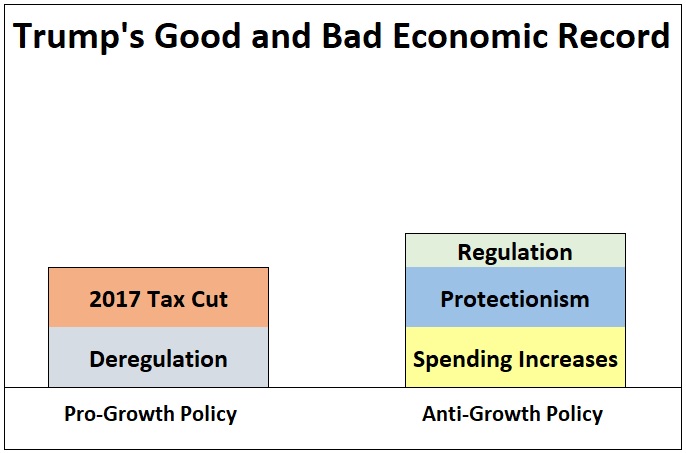
The net result, I wrote, was that, “his overall record was flat. Or perhaps slightly negative.”
The obvious takeaway is that you have to look at the net effect of all his policies, and that’s going to be a theme for today’s column about trade.
More specifically, in a column for the Washington Post, Matthew Lynn defends Trump’s protectionist trade taxes and claims economists have egg on their faces.
His evidence is that some economists predicted economic doom yet the economy is not in recession. Here are some excerpts.
Inflation would surge. Supply chains would crash. And the economy would be plunged into a deep recession while the stock market tanked. When President Donald Trump imposed huge tariffs on imports in April, the mainstream economic establishment and the big forecasters on Wall Street were virtually united on one point: The tariffs would trigger stagflation, at best, and a deep slump, at worst. …And yet, six months on, events have not unfolded that way. The big thinkers got this one wrong — and if economics is to maintain any credibility, they need to address why that happened. …to start with, the economic mainstream suffers from Trump derangement syndrome. …Next, …one thing a liberal economy does very well is adapt to change. Most businesses have simply taken the tariffs in their stride and moved on. History tells us that free markets can cope with wars, plagues and revolutions. It was always slightly absurd to argue that 20 percent levies on Vietnamese-made Halloween masks would be the end of the world. …tariffs are working at least reasonably well. They are bringing in an expected $400 billion a year of extra tax revenue, with little negative impact… These experts who purport to understand how the economy functions saw the tariffs as a catastrophe. They were wrong; they need to admit it.
Lynn is right. Some economists overstated the damage of trade taxes. And some of them may have been motivated by anti-Trump sentiments.
But that doesn’t change the fact that protectionism is bad for the economy.
Here are five points to keep in mind. The first three apply to all policy analysis and the last two apply specifically to trade policy.
Economists are lousy forecasters. If they actually knew how to predict the economy, they could make millions or even billions of dollars in financial markets. What economists should do – and can do – is assess whether a particular policy will cause more growth or less growth.
It is very difficult to dramatically change the economy, so even a very good policy may only cause the economy to grow by, say, an extra 2/10ths of 1 percent per year (and vice-versa for a bad policy). Of course, because of compounding, even small changes can lead to big long-term differences in prosperity.
The policy lever that is most likely to cause a recession isn’t trade policy or tax policy. It’s monetary policy. Almost all recent economic downturns (the COVID lockdown being the exception) were caused by misguided boom-bust policies by the Federal Reserve.
Regarding trade, there are two major measures of economic liberty (Economic Freedom of the World and Index of Economic Freedom) and trade only accounts for about 20 percent of a nation’s grade. So it is easy to have bad policy in one area that is offset by good policy in other areas (and vice-versa).
Some estimates of serious economic damage were made after Trump’s so-called Liberation Day trade taxes were announced. After the adverse reaction in financial markets, Trump backed off. The chart shows that Trump has made trade policy worse, but the overall tax increase on trade is not nearly as bad as originally planned, so it should not be a surprise that the damage has not been as severe.
The bottom line is that most bad policies – including trade – are like cancer or some other debilitating illness. They don’t kill you right away, but your health obviously goes downhill.
And in some cases, the net damage of an illness can be offset by something positive, like losing 50 lbs and starting to exercise.
That’s how I viewed Trump’s first term, and it seems to be a reasonable way of looking at his second term. His trade policy is terrible, but his spending policy seems to have improved. And he is doing good things on taxes and red tape.