Let’s use Moldova as an example. I’m currently in that country for a speech that will focus of rule of law and the quality of the judicial system.
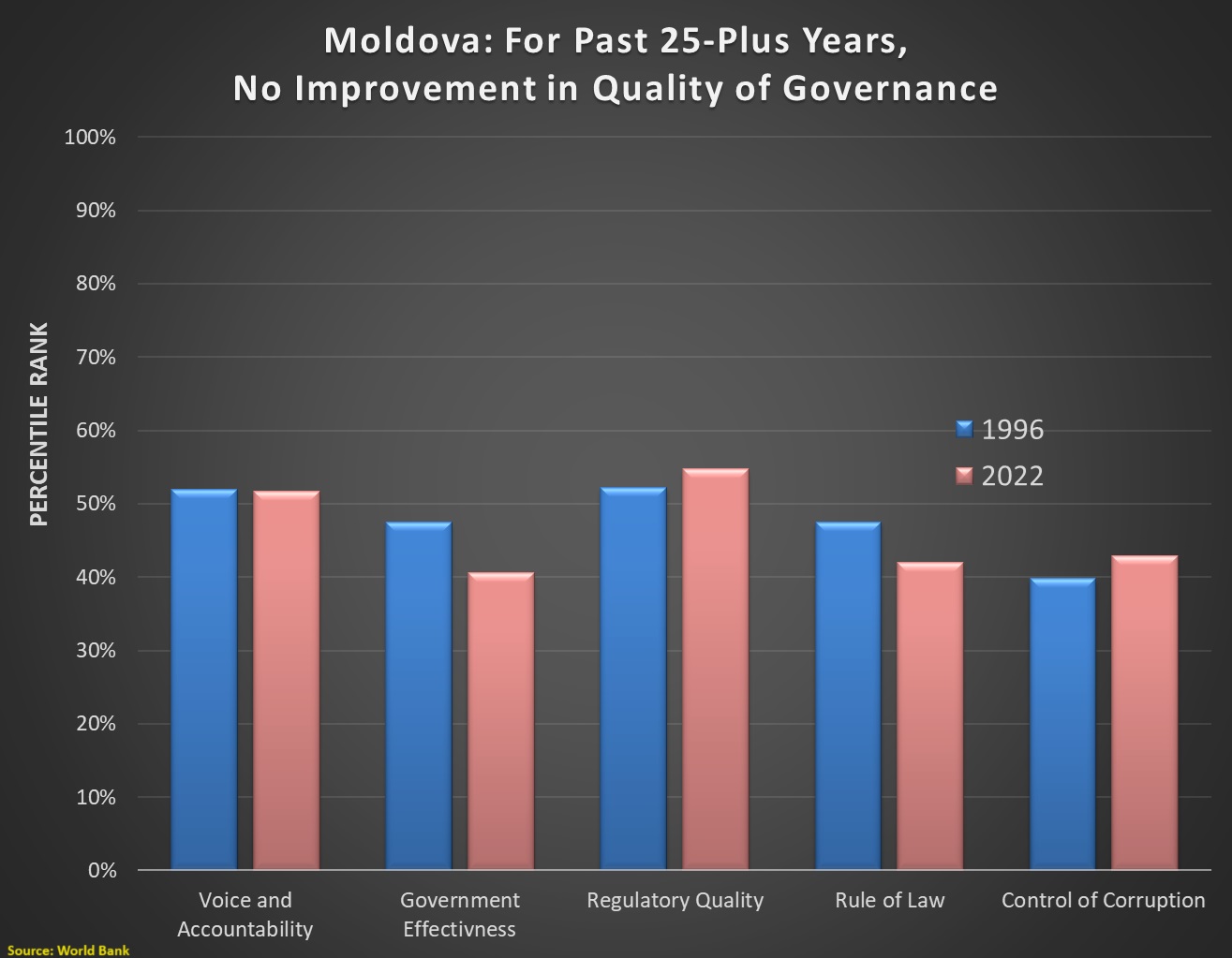
As part of my research, here are the World Bank Governance Indicators for Moldova in 1996 (shortly after it achieved independence from the Soviet Union) and 2022 (the most-recent data). As you can see, modest improvements in two areas is offset by modest declines it three other areas.
Incidentally, I didn’t even include the “Political Stability” category, which dropped significantly. I’m guessing that Russia’s invasion of Ukraine (which borders Moldova) has played a role in that decline, and it would not be fair to blame the current Moldovan government for having a conflict next door.
The bottom line is that Moldova has not taken advantage of independence, at least when measuring quality of governance.
Why should this matter to American readers? Or to readers from just about any place other than Moldova.
Well, it should matter to Americans (and Europeans and Japanese) because we’re helping to finance Moldova’s government.
With regards to American aid, here are some excerpts from a recent Associated Pressreport by Matthew Lee and Vadim Ghirda.
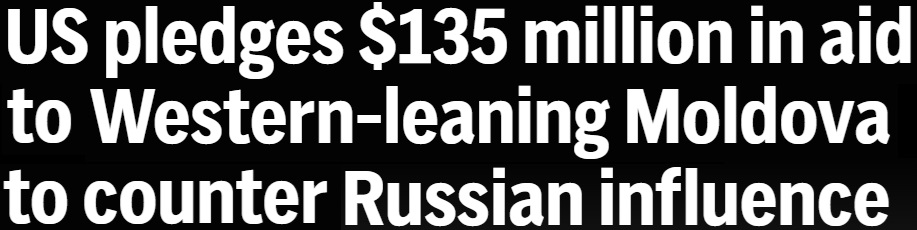
U.S. Secretary of State Antony Blinken…pledged $135 million in aid to Moldova for energy security and to counter Russian disinformation as the Western-leaning nation struggles to blunt Moscow’s push for influence that has been buoyed by recent successes in its war in neighboring Ukraine. Blinken opened a short visit to Eastern Europe with a stop in Chisinau, Moldova’s capital, where he announced the assistance at a news conference with President Maia Sandu. America’s top diplomat said $85 million would go to bolster energy infrastructure and $50 million was aimed at overhauling the energy and farming industries and deterring disinformation. …the U.S. had provided Moldova with $774 million in financial aid since the Ukraine war began in February 2022. Some $300 million of that was earmarked for energy security. …Sandu thanked the U.S. for its financial support, …“Thanks to the financial American assistance of $80 million, in the past winter we managed to compensate the energy bills of our citizens.”
So, among other things, U.S. aid is being used to subsidize energy consumption in Moldova.
I don’t think that the U.S. government should subsidize anyone’s energy bills, either at home or abroad.
For what it’s worth, my philosophical objections to foreign aid don’t apply to money that is used to buy friends. If someone can convince me that handouts to a foreign government will keep that country from siding with Russia (or some other unfriendly country), that might be worth it.
But I’m very skeptical that the U.S. handouts to Moldova are achieving that goal. Heck, foreign aid might even backfire (as it probably did in pre-war Ukraine…and probably will in post-war Ukraine).
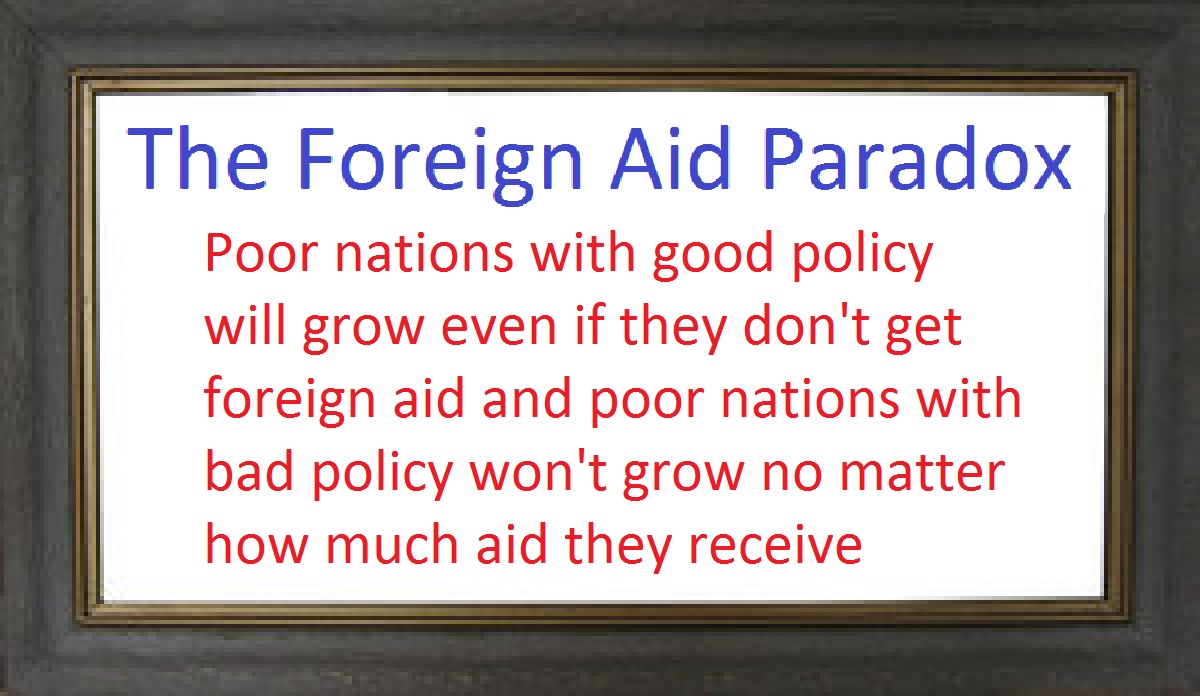
But if politicians insist on sending taxpayer money to other nations (either to make themselves feel good or to buy friends), the funds should be tied to something concrete, such as better scores on the World Bank’s Governance Indicators.