Why has there been a revolution for school choice?
There are three possible answers.
The evidence is now overwhelming that dumping more money into monopoly government schools doesn’t produce better results. More funding for government schools simply leads to more bureaucracy. It’s a classic case of “throwing good money after bad.”
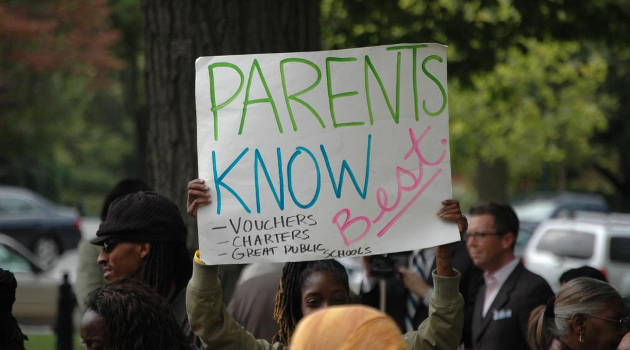
Families want the freedom to choose the best education for their kids and they have been rejecting politicians who side with the education establishment. Since getting reelected is the main goal of 99.9 percent of politicians, that is encouraging otherwise reluctant state lawmakers to support choice.
For today’s column, let’s expand upon the third reason that school choice is booming.
Here are some of the highlights of a new report from Children’s Scholarship Fund Philadelphia.
Children’s Scholarship Fund Philadelphia (CSFP) students’ test scores were compared to students attending School District of Philadelphia (SDP). Fourth and Seventh grade scholarship recipients’ standardized test scores in Math and Reading/ELA were compared to all children attending a public school and those eligible for the Federal Free and Reduced Lunch program… CSFP students fare much better at a private school compared to students attending a school in the School District of Philadelphia (SDP). For example, 47% of CSFP 4th grade students score at or above proficiency in Math compared to 23% of SDP students and 17% of low-income SDP students. The same is true for 7th graders, where 54% of 7th grade CSFP students score at or above proficiency in Math, while only 19% of all SDP and 14% lower-income SDP students score at or above proficiency. …CSFP partner schools outperform SDP district schools in both years, both subjects and at both grade levels. Over 58% of 7th graders at a CSFP school score at or above proficiency in Reading compared to 38% of 7th graders attending a traditional public school in the district. … Over half (52%) of 4th graders at a CSFP partner school score at or above proficiency in Math, while only 47% of all students and 31% of lower income students score at or above proficiency attending a school within a 10-minute drive.
Another way to tell that private schools are better is to see which option parents prefer when they actually have a choice.